Indices signals & analysis
Trade US30, Nasdaq, SPX500 and DAX40 with a clear plan
Daily key levels and straightforward indices analysis, shared free with our trading community.
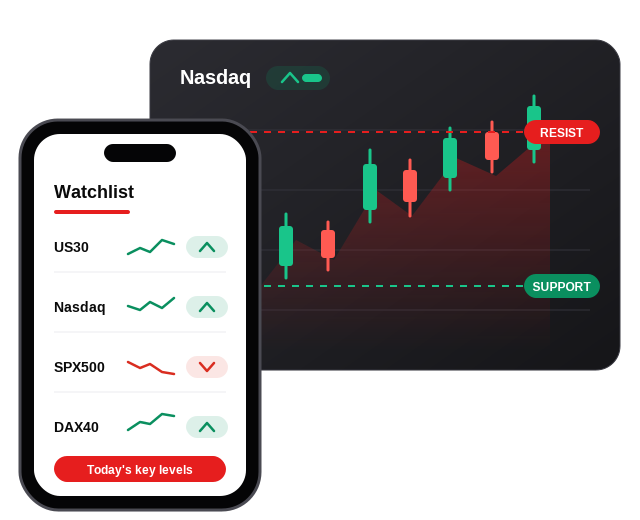
Get free indices setups
Tell us what you trade and we will add you to the right community group.
Updated daily
Today’s key levels
Support, pivot and resistance for the major indices, refreshed automatically every trading day from the previous session.
| Index | Resistance | Pivot | Support | Bias |
|---|---|---|---|---|
| US30 (Dow Jones) | 50,747.5 | 49,830.6 | 49,266.0 | Bullish |
| Nasdaq 100 | 26,428.8 | 25,699.7 | 25,317.8 | Bullish |
| SPX500 (S&P 500) | 7,264.7 | 7,117.4 | 7,035.5 | Bullish |
| DAX40 | 25,306.2 | 25,210.2 | 25,119.6 | Neutral |
The basics
What are indices signals?
An indices signal is a trade idea on a stock index such as the US30, Nasdaq, SPX500 or DAX40. Instead of analysing hundreds of individual shares, you follow one market that reflects a whole economy or sector.
A useful signal is more than a direction. It tells you where the idea starts, where it is proven wrong and what a realistic target looks like, so you can judge the risk before you take the trade.
At Trade Indices every idea comes with the reasoning behind it. The aim is not to make you depend on alerts, but to help you read the levels yourself.
Every idea we share includes
- The level – the support or resistance zone the idea is built on
- The direction – buy or sell bias and what would change it
- The invalidation – the price where the idea is simply wrong
- The targets – realistic areas to take profit
- The reasoning – why the level matters today
Market breadth
Nasdaq 100 heatmap
See which stocks are pushing the index up or dragging it down right now. Bigger blocks carry more weight in the index.
How to read it: when most of the map is green, the move in the index has broad support. When only a few large names are green and the rest are red, the rally is narrow and more likely to fade.
Markets
The indices we cover
Four markets, covered every trading day. Start with what moves each one, when it is most active and how traders approach it.
US30
Dow Jones 30
Thirty blue-chip US companies. Price-weighted, fast moving and popular at the New York open.
NASDAQ
Nasdaq 100
The tech-heavy benchmark. High volatility and strong trends driven by the largest growth stocks.
SPX500
S&P 500
The broad US market in one index. Smoother moves and the reference point for global risk.
DAX40
DAX 40
Germany’s leading index. The main European session mover, active from the Frankfurt open.
Why indices
Why traders choose indices
Indices suit traders who want clear structure, deep liquidity and a market that respects its levels.
One market, the whole picture
An index moves on the economy, interest rates and sentiment. You do not need to follow company news for hundreds of separate shares.
Trade both directions
Index CFDs can be bought or sold, so there are opportunities in rising and falling markets alike.
Clear daily rhythm
Each index has a home session with a predictable burst of activity: Frankfurt for the DAX40, New York for US30, Nasdaq and SPX500.
Levels that matter
Previous highs and lows, pivots and round numbers are watched by a huge number of participants, which is why price reacts to them.
Our process
How we analyse the market each day
A simple, repeatable routine. You can follow the same steps on your own charts.
1
Mark the levels
We start from the previous session’s high, low and close, the pivot, and the overnight range. These become the map for the day.
2
Check the calendar
CPI, NFP, FOMC and central-bank speakers change how price behaves around a level. News comes before any trade idea.
3
Wait for price
A level is only interesting when price reaches it and reacts. We share the idea with its invalidation and targets at that point.
4
Review the result
Winning or losing, each idea is reviewed in the community so the lesson is clear and nothing is hidden.
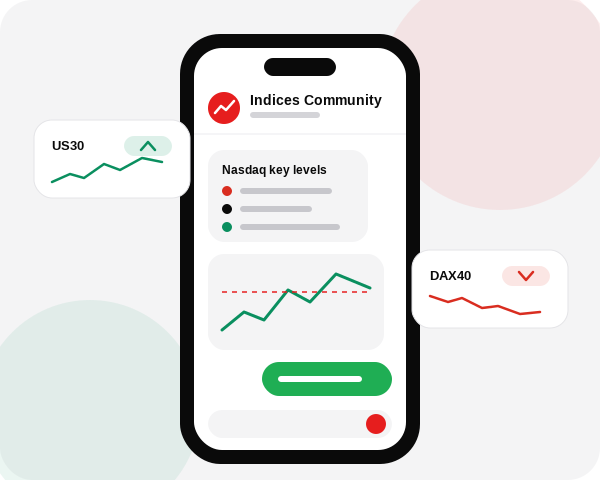
Free community
Key levels and analysis, straight to your phone
No dashboards to keep checking. Join on the app you already use and get the day’s levels and market updates as they are posted.
- Daily key levels for US30, Nasdaq, SPX500 and DAX40
- Updates around CPI, NFP, FOMC and other major releases
- Analysis that explains the reasoning, win or lose
- A place to ask questions and learn from other traders
Trade responsibly
Risk comes first
Indices are leveraged and fast. These three habits matter more than any single signal.
Size every trade
Decide how much of your account you are prepared to lose on one idea, then work out the position size from your stop distance. Many traders keep this to a small, fixed percentage.
Always use a stop
Place the stop where the idea is wrong, not where it feels comfortable. If that stop is too far for your account, the trade is too big, not the stop.
Respect the news
Spreads widen and price can jump in both directions around major releases. Reducing size or waiting for the first reaction to settle protects your capital.
Nothing on this website is financial advice. Read our risk disclaimer before trading.
This week
Economic calendar
CPI, NFP, FOMC and other high-impact releases move indices fast. Check what is scheduled before you trade.
Blogs
Latest blogs
Market breakdowns, trade ideas explained and lessons from the charts.
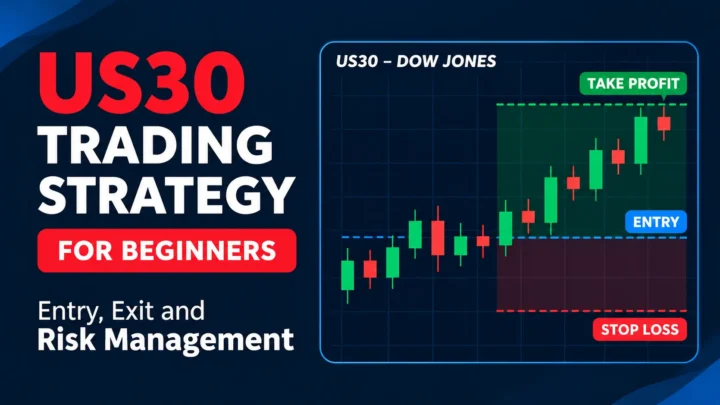
US30 Trading Strategy for Beginners: Entry, Exit and Risk Management
A US30 trading strategy is a set of rules that helps traders identify entry points, plan exits, and manage risk when trading…
Frequently asked questions
What are indices signals?
Indices signals are trade ideas for stock indices such as the US30, Nasdaq, SPX500 and DAX40. A signal normally includes a direction, an entry area, a stop level and targets. Ours are shared for education, with the reasoning explained.
Is the TradeIndices community free?
Yes. Joining the WhatsApp or Telegram community is free. Fill in the short form or tap one of the community buttons to join.
Which indices do you cover?
Our main focus is the US30 (Dow Jones), Nasdaq 100, SPX500 (S&P 500) and DAX40. We also comment on other major indices when they are driving the market.
Do I need a large account to trade indices?
No, but you do need to manage risk carefully. Indices are leveraged products and can move quickly, so position size should always be based on how much you can afford to lose on a single trade.
Is this financial advice?
No. Everything we publish is educational and general in nature. It does not take your personal circumstances into account, and you are responsible for your own trading decisions.