US30 Trading Strategy for Beginners: Entry, Exit and Risk Management
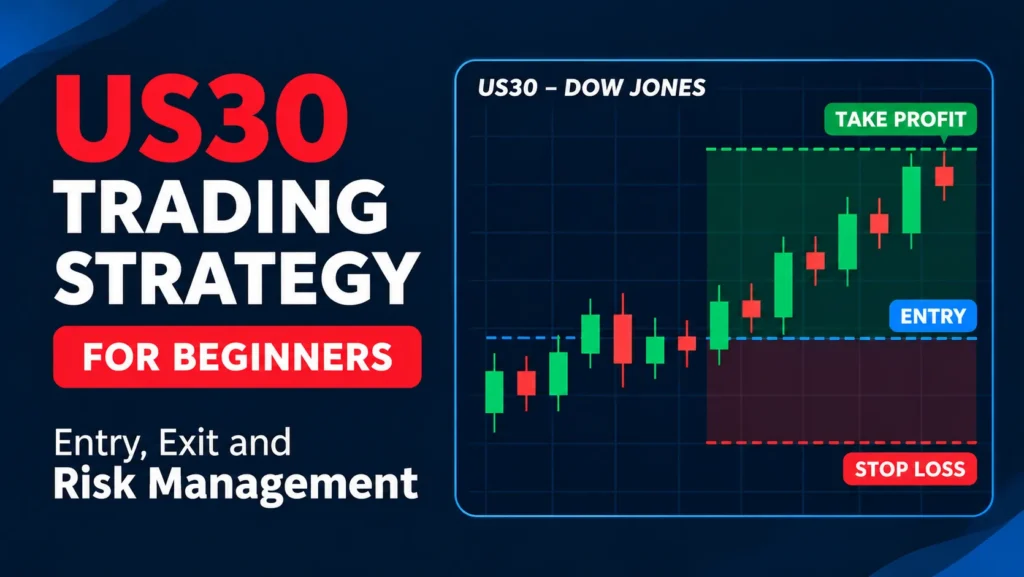
A US30 trading strategy is a set of rules that helps traders identify entry points, plan exits, and manage risk when trading the Dow Jones index. It combines market analysis, price action, trade timing, and position sizing.
Beginners can start by studying market trends, marking key price levels, and waiting for a clear entry signal.
Whether you already trade gold or are new to indices, understanding how US30 moves can help you build a more structured trading plan.
This guide explains practical trading setups, entry and exit rules, and common risks in simple terms.
What Is US30 in Trading?
US30 is a trading symbol commonly used for financial products linked to the Dow Jones Industrial Average (DJIA). The index tracks 30 major American companies.
According to S&P Dow Jones Indices, the Dow is a price-weighted index. This means companies with higher share prices have more influence on its movement.
Unlike an individual stock, US30 reflects the combined performance of a group of companies.
Some brokers use names such as:
- US30
- Dow Jones 30
- Wall Street 30
- US Wall St 30
For example, OANDA’s US Wall St 30 instrument is linked to the Dow Jones index.
Although traders often search for the US30 stock, it is not an individual company share.
What Is US30 in Forex Trading?
US30 is often available on platforms that offer forex, gold, and indices trading. However, it is not a forex currency pair.
The US30 forex symbol usually refers to an index-based trading product, such as a contract for difference (CFD).
A CFD allows traders to take positions on price movements without owning the underlying shares.
Traders can open a buy position when they expect prices to rise or a sell position when they expect prices to fall. Both positions carry the risk of financial loss.
What Moves the US30 Index?
Understanding market drivers is an important part of learning how to trade the Dow Jones.
Several factors can influence its price.
- US economic data: Employment, inflation, and growth reports can affect market sentiment.
- Interest rate decisions: Federal Reserve announcements may change expectations about business growth and borrowing costs.
- Company earnings: Financial results from companies within the index can affect its value.
- Global events: Political tension, trade disputes, and economic uncertainty may cause sudden price changes.
- Market sentiment: Changes in investor confidence can create buying or selling pressure.
Gold traders may already follow some of these events. However, US30 and gold do not always react in the same way.
Best US30 Trading Strategy Setups for Beginners
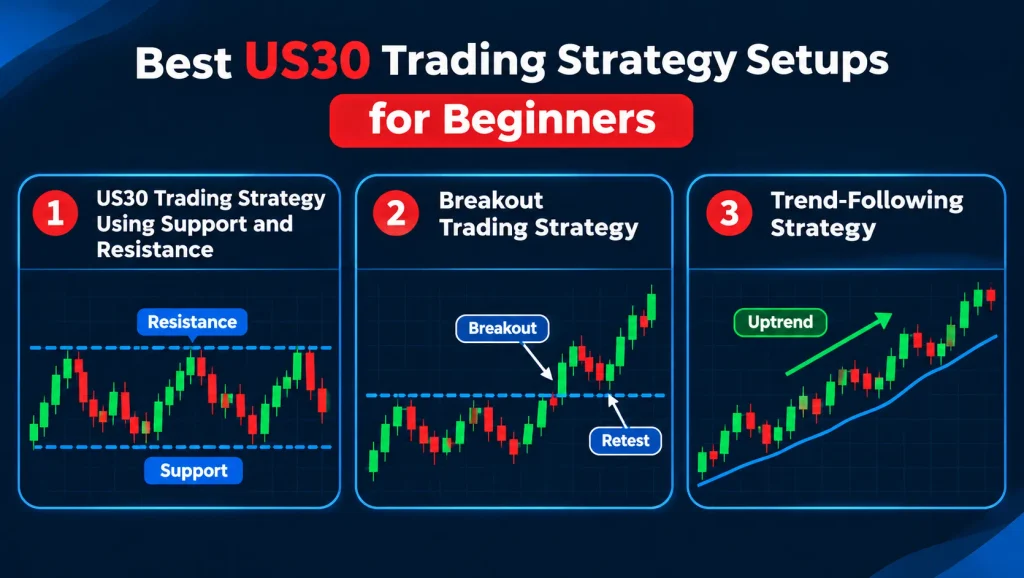
A trading setup defines the conditions that must appear before a trader considers opening a position.
The following approaches are commonly used to study index price movements.
1. US30 Trading Strategy Using Support and Resistance
Support is a price area where buying pressure may slow a decline. Resistance is an area where selling pressure may slow a rise.
Traders mark these levels using previous market highs and lows.
Entry: Wait for a clear price reaction near support or resistance before considering a position.
Stop-loss: Place the planned stop beyond the price area that would invalidate the setup.
Exit: Use the next relevant support or resistance area as a possible target.
These levels are not guaranteed to hold. Strong market moves can break through them.
2. Breakout Trading Strategy
A breakout occurs when the price moves beyond an established trading range or key price level.
Instead of entering as soon as the price crosses a level, traders may wait for the candle to close outside the range.
A retest happens when the price returns to the broken level.
If the level holds during the retest, it may provide another entry signal.
False breakouts remain a risk, even when the price appears to confirm the move.
3. Trend-Following Strategy
Trend following involves looking for trades that align with the main market direction.
An uptrend generally forms higher highs and higher lows. A downtrend forms lower highs and lower lows.
Traders may use a moving average to help identify the trend.
Rather than chasing a sharp move, they can study temporary price pullbacks for possible entries.
The main challenge is identifying when a trend is weakening or changing direction.
How to Trade the Dow Jones: Entry and Exit Rules
A clear entry and exit plan can reduce impulsive trading decisions.
Identify the Market Direction
Start with a higher time frame to understand the broader trend.
Then use a shorter time frame to study possible entry points.
If the market lacks a clear direction, waiting may be more suitable than forcing a trade.
Wait for Entry Confirmation
An entry signal may include a price rejection, a breakout retest, or a clear change in market structure.
A single candle does not guarantee that the price will continue in the expected direction.
The entry should follow the rules of the selected setup.
Plan the Stop-Loss and Take-Profit
A stop-loss is an order intended to close a position when the market reaches a set loss level.
A take-profit order aims to close a trade at a chosen price target.
Both levels should form part of the trading plan before entry.
During fast markets, stop orders may execute at a different price from the requested level.
Example of a US30 Trading Setup
Suppose US30 moves above a resistance level and later returns to test it.
A trader notices that buyers appear near the broken level. This creates a possible breakout retest setup.
The trader identifies an entry point, places a planned stop below the retest area, and selects the next resistance level as a possible target.
If the price falls back through the level, the original trade idea may no longer be valid.
This example explains the process, not a live trading recommendation.
US30 Risk Management for Beginners
Risk management is a core part of any US30 trading strategy. Even a well-planned trade can result in a loss.
| Risk Management Rule | Purpose |
| Position sizing | Controls exposure to market movements |
| Stop-loss planning | Helps limit potential trading losses |
| Leverage control | Reduces excessive market exposure |
| Daily loss limit | Helps prevent continued trading after losses |
| Economic calendar | Identifies events that may cause volatility |
| Trading journal | Helps review decisions and mistakes |
Position size depends on the planned stop distance, the contract’s value per point, and the amount a trader can afford to lose.
A basic position size formula is:
Position Size = Planned Cash Risk ÷ (Stop Distance × Value per Point)
The value per point must match the broker’s contract specifications. Trading fees and slippage can increase actual losses.
The UK’s Financial Conduct Authority (FCA) identifies CFDs as high-risk products that may not suit all retail traders.
European and Gulf traders should also check local rules, broker authorisation, and available client protections.
What Is the Best Time to Trade US30?
US30 often sees increased market activity around the New York stock market opening.
According to the New York Stock Exchange trading hours, its regular stock market session runs from 9:30 AM to 4:00 PM Eastern Time.
For European traders, the US market opens during the afternoon. For many Gulf traders, it opens during the late afternoon or early evening.
Local times may change due to daylight saving time.
Index CFDs may have longer trading hours than the underlying stock market. Actual hours depend on the broker and product.
Higher market activity can also bring sudden price changes, wider spreads, and greater execution risk.
Common US30 Trading Mistakes to Avoid
New traders often focus on finding entries without giving enough attention to risk.
Common mistakes include:
- Entering without a clear trading setup.
- Using excessive leverage.
- Moving stop-loss levels to avoid accepting a loss.
- Ignoring major economic announcements.
- Opening too many positions.
- Trying to recover losses through impulsive trades.
- Ignoring spreads and overnight charges.
Testing a trading plan on a demo account can help traders understand how the rules work before risking real money.
However, demo results do not guarantee similar results in live trading.
Conclusion
A well-defined US30 trading strategy combines clear entry rules, planned exits, market analysis, and risk management.
Understanding how to trade the Dow starts with learning how the index moves and which events affect its price.
Traders should focus on following a tested plan rather than chasing every market move. Position sizing, stop-loss planning, and control over leverage are important parts of that process.
No strategy can remove trading risk. Consistent learning and careful trade review can help traders develop a more informed approach to indices trading.
Risk Disclaimer: This article is for educational purposes only and does not constitute personalised financial advice. Trading indices and leveraged CFDs involves substantial financial risk, including the possible loss of invested capital. Product availability and investor protections vary by jurisdiction.
Frequently asked questions
What Is US30?
US30 is a common trading symbol for products that track the Dow Jones Industrial Average, an index of 30 major US companies.
Is US30 a Forex Pair or a Stock?
US30 is neither a currency pair nor an individual stock. It represents a trading instrument linked to a stock market index.
Is 30 Wall St the Same as US30?
Both names commonly refer to products linked to the Dow Jones Industrial Average. However, contract sizes, pricing, and trading conditions may differ between brokers.
Is Forex 30 Another Name for US30?
Forex 30 is not a standard symbol for the Dow Jones. Traders may use this search term when looking for US30 on forex trading platforms.
Which US30 Trading Strategy Is Best for Beginners?
Support and resistance, trend following, and breakout retest setups are relatively straightforward to study. No single strategy works in every market condition.
Can Beginners Trade US30?
Beginners can study US30 using demo accounts. Live trading involves financial risk, especially when using leveraged CFDs.